
The Silicon Shockwave: What the Nvidia Leadership Crisis Teaches African Enterprises About Key-Person Risk and Compute Sovereignty
The Silicon Shockwave
Key-Person Risk, Foreign Intelligence Probes & Africa's AI Compute Sovereignty (2026/2027)
On Thursday, November 12, 2026, the global technology landscape witnessed an unprecedented earthquake: Jensen Huang, the iconic co-founder who steered Nvidia for 33 years from a Silicon Valley Denny's booth into the most valuable semiconductor enterprise on earth, officially resigned as President, Chief Executive Officer, and Board Member.
The sudden collapse of Silicon Valley's most venerated chief executive was triggered by a dual-front crisis: a U.S. federal and board-level investigation into an extramarital relationship with Alice Huang—an executive at Singapore-based cloud partner Megaspeed International suspected by Western intelligence of funneling restricted high-end AI chips into Beijing—compounded just days later by reporting from The New York Times exposing a secondary internal affair with a direct subordinate, Nvidia's VP of Healthcare Kimberly Powell. In the immediate aftermath, Nvidia shares plummeted over 10%, vaporizing hundreds of billions in market capitalization and prompting the emergency appointment of CFO Colette Kress as interim CEO alongside Harvey C. Jones as the company's first-ever independent board Chairman.

“The Nvidia catastrophe carries two profound truths for African business leaders. First, no enterprise—regardless of whether it commands $3 trillion or $3 million—can afford to concentrate strategic leverage inside the mind of a single charismatic founder without institutional governance. Second, relying exclusively on foreign hardware monopolies for artificial intelligence is an existential gamble. Africa cannot be a mere consumer of foreign silicon; we must architect sovereign, distributed, and compute-efficient systems.”
Kenny Loi MUKIZA
Product Strategy Lead · Initiative Tech Solutions Ltd
Nvidia's board of directors confirms an active independent inquiry led by outside counsel following intelligence disclosures regarding Jensen Huang's undisclosed relationship with Alice Huang, an executive at Singapore-based data center operator Megaspeed International, scrutinized by federal regulators for GPU diversion into China.
The New York Times publishes an investigative report detailing a secondary, internal affair between Huang and Kimberly Powell, Nvidia's Vice President of Healthcare, presenting an undeniable breach of internal HR conflict-of-interest policies. The board convenes an emergency session.
Jensen Huang tenders his immediate resignation as CEO and board member. Nvidia files regulatory disclosures appointing Chief Financial Officer Colette Kress as interim CEO and naming veteran director Harvey C. Jones as independent board Chairman. Shareholder class-action litigation is filed in federal court.
1. The Corporate Governance Warning: Dismantling "Key-Person Risk"
For three decades, Nvidia was celebrated for its radical flat management structure. Jensen Huang famously operated with 40 to 50 direct reports, no formal management hierarchy, and an explicit refusal to implement formal executive succession planning. In business school case studies, this was hailed as the peak of agility.
On November 12, the world saw the devastating cost of that design: the Single Point of Failure (SPOF). When an enterprise's market valuation, strategic supplier relationships, and operational momentum reside solely in the persona of one individual, any personal compromise or regulatory scandal becomes an existential corporate liquidity crisis.

Figure 1: Institutional stability requires decentralized authority, auditable operational workflows, and dual-control executive governance.
Why African Enterprises Face the Exact Same Vulnerability
Across Rwanda and East Africa, hundreds of medium-to-large businesses suffer from acute founder-dependency. In family-owned trading conglomerates, agricultural exporters, private hospital groups, and fast-growing fintech startups, crucial operational assets remain locked in the owner's WhatsApp chats, personal bank approvals, and verbal directives:
01. Opaque Approval Workflows
When single founders personally approve every purchase order, vendor disbursement, and payroll cycle, the enterprise freezes whenever leadership travels or faces personal adversity.
02. Lack of Auditable Operational ERP
Without centralized enterprise resource platforms like Inzora Business Suite (IBS), institutional memory vanishes when key executives leave, exposing companies to massive regulatory and financial liabilities.
Modern enterprise software exists precisely to insulate organizations against human volatility. By deploying automated double-entry general ledgers, role-based access control (RBAC), multi-tier digital authorization matrices, and immutable transaction logs, Rwandan businesses can ensure their balance sheet and commercial operations thrive independently of any single individual.
2. The Tech & Geopolitics Warning: Escaping the Silicon Monopoly
The second shockwave from the Nvidia investigation is geopolitical: the weaponization of semiconductor supply chains.
The crux of the federal investigation centers on Megaspeed International—a Southeast Asian data center operator that purchased immense allocations of Nvidia H100 and Blackwell B200 accelerators, allegedly serving as an intermediary pipeline into sanctioned Chinese tech firms. In response to this breach, Washington is preparing sweeping audits on global GPU shipments, tightening end-user verification across neutral third-party hubs in the Middle East, Southeast Asia, and Africa.

Figure 2: The global AI race is throttled by extreme hardware concentration. Over 85% of advanced AI training compute has been controlled by a single silicon architecture.
The African Reality: The Threat of "Compute Colonization"
Africa represents 20% of the world's population, yet commands less than 1% of the planet's data center capacity. For the past two years, African artificial intelligence startups—from health diagnostic teams in Kigali to agricultural fintechs in Nairobi—have been forced into an unsustainable dependency loop:
- Dollar-Denominated Latency & Cost: Routing local data to cloud clusters in Virginia, Frankfurt, or Dublin incurs punishing API costs, foreign exchange drain, and high latency that cripples real-time IoT or telemedicine applications.
- Data Protection Violations: Transferring citizen health records, financial telemetry, and identification data to foreign jurisdictions directly breaches sovereign regulatory frameworks like Rwanda's Law Nº 058/2021 relating to the Protection of Personal Data and Privacy.
- Sanctions & Export Collateral Damage: When global powers tighten semiconductor export audits to catch smuggling rings, African research institutions and domestic cloud operators face extreme shipment delays, inflated gray-market pricing, and arbitrary hardware allocations.
3. Strategic Roadmap: Building Africa's Sovereign AI Architecture
How do African tech founders, enterprise architects, and policymakers respond to the Nvidia shockwave? At Initiative Tech Solutions (ITS) Ltd, based inside Kigali's premier startup ecosystem at Norrsken House, we advocate for a three-tier sovereign tech strategy:
Tier 1: Small Language Models (SLMs)
Stop burning capital on bloated 400B-parameter generalist models. Fine-tune task-specific, open-weights Small Language Models (e.g., Llama 3.2, Mistral, Gemma) that run efficiently on commodity enterprise hardware or localized regional GPUs.
Tier 2: Domestic Cloud & Hybrid Data Centers
Anchor sensitive financial, medical, and governmental workloads inside certified domestic tier-3 data centers in Kigali and regional hubs. Process data locally, ensuring absolute Law Nº 058/2021 compliance and zero foreign jurisdiction exposure.
Tier 3: Multi-Architecture Silicon Parity
Avoid proprietary vendor lock-in (CUDA lock-in). Build software stacks with Triton, PyTorch, and ONNX backends capable of running seamlessly across AMD ROCm, Intel Gaudi, custom TPUs, and emerging edge AI NPUs.
Conclusion: Resilience Over Reliance
The sudden collapse of Jensen Huang's 33-year tenure at Nvidia is a watershed moment for the global technology industry. It proves that no tech monopoly is invulnerable, no executive is immune to governance standards, and no corporation can maintain sustained market dominance without institutional systems that transcend personality.
For African business leaders and techpreneurs, the message is unmistakable: audit your internal governance, eliminate key-person dependencies through disciplined enterprise software, and invest in sovereign, sustainable digital infrastructure. The future of African commerce cannot be rented from Silicon Valley—it must be engineered right here at home.
Future-Proof Your Enterprise Infrastructure
Whether you need to eliminate operational bottlenecks with Inzora Business Suite (IBS), conduct an enterprise cybersecurity audit, or architect a sovereign domestic cloud deployment in Rwanda, the ITS Ltd engineering team is ready to assist.
Article Intelligence
Strategic Alliance
Enterprise digital alignment requires tactical precision. Partner with the ITS Ltd implementation team.
Further Intelligence
Browse All Articles →
Why You Should Visit Rwanda as a Techpreneur: The Silicon Valley of Africa (2027)
From 6-hour digital business incorporation and visa-on-arrival for every global citizen to the vibrant innovation hub at Norrsken House Kigali, discover why Rwanda is the ultimate launchpad and testbed for tech founders, angel investors, and software visionaries entering the African Continental Free Trade Area (AfCFTA).
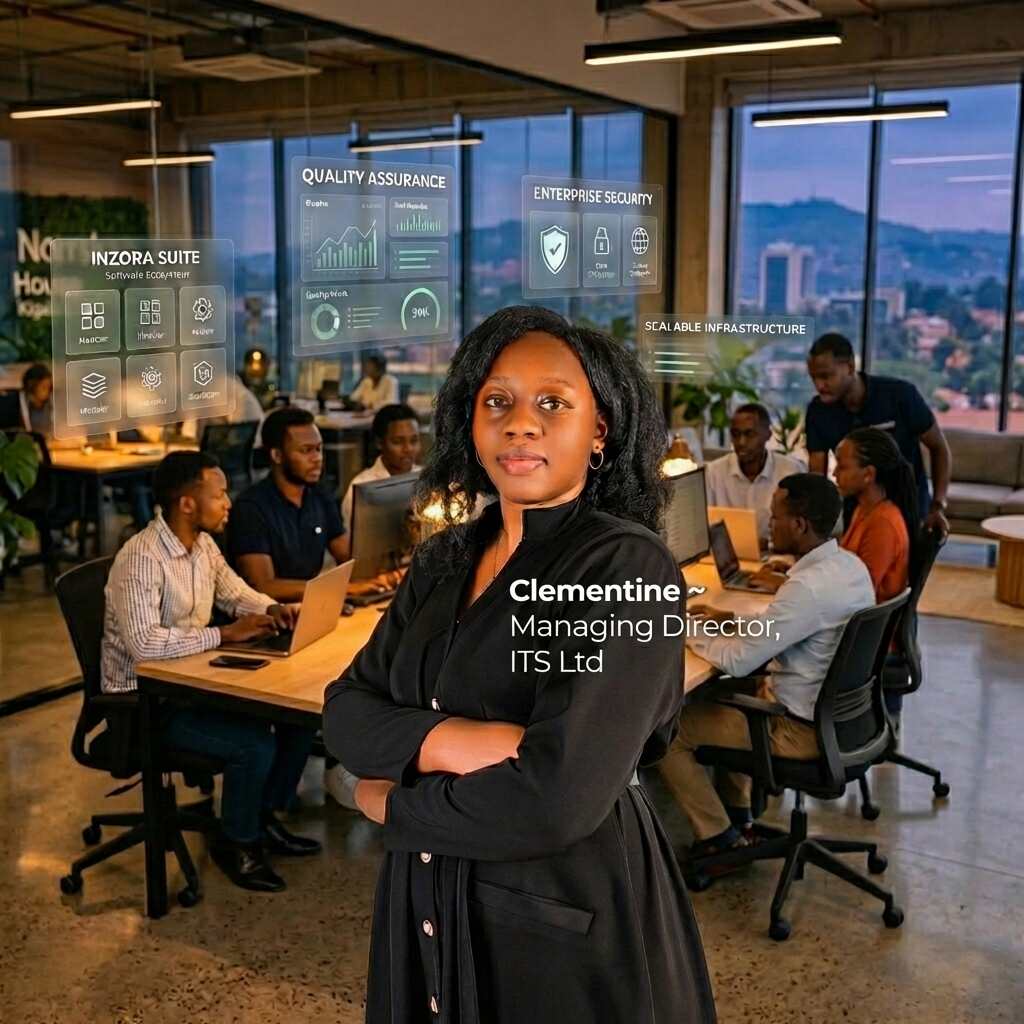
Clementine Ishimwe: Rwandan Tech Innovator Revolutionizing E-Commerce and Security
As CEO & Managing Director of Initiative Tech Solutions (ITS Ltd), Clementine Ishimwe is redefining the African digital frontier. From engineering localized, high-trust e-commerce ecosystems that integrate mobile money to establishing institutional-grade cybersecurity frameworks for SMEs, explore how her leadership is bridging the digital divide and driving sustainable digital sovereignty across East Africa.